Buying committee clarity
Decision-maker research without org-chart cosplay
pomgunrex helps qualitative teams name who actually moves B2B deals—economic buyers, champions, vetoes, and quiet influencers. In many U.S. firms, the person running QuickBooks holds more practical power than the slide deck admits.
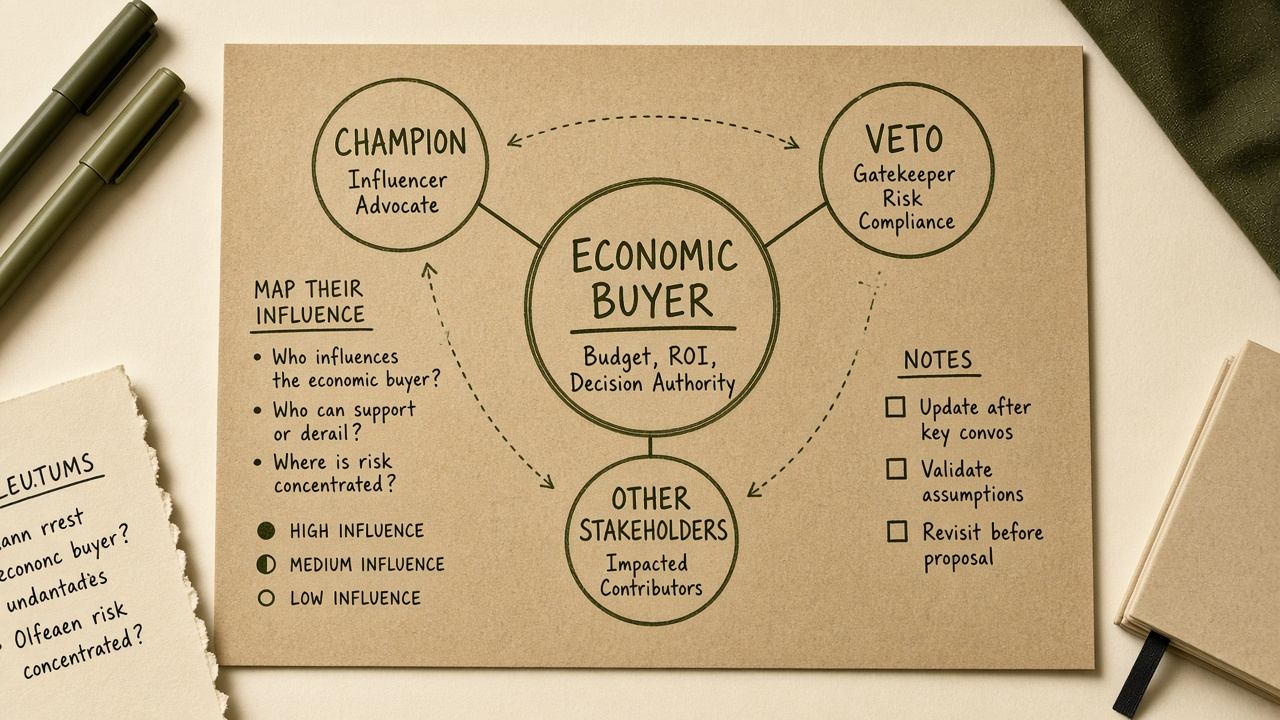
Role comparison
Three formal roles—and what each optimizes for
Economic buyer
Signs budget, owns ROI narrative, rarely uses the product daily. Ask about risk thresholds and what evidence survived the last board conversation.
Typical signal: “We need this to pay back in two quarters.”
Champion
Drives internal momentum, schedules demos, fights for pilot time. Champions over-promise fit; verify their influence with second interviews.
Typical signal: “I can get finance on a call next week.”
Veto holder
Can stop a deal without saying no loudly—security, legal, IT, or finance operations. Vetoes often appear as “we need another review cycle.”
Typical signal: “We are not changing close week.”
4–9
Stakeholders cited in mid-market deals
2×
Interviews needed to confirm champion power
1
Finance gate often invisible in CRM
0
Assumed titles without transcript proof
Informal influencers and shadow approvers
Titles lie. pomgunrex treats decision-maker research as a network problem: who gets forwarded emails, who is copied on security threads, who owns the spreadsheet everyone trusts. Informal influencers rarely appear on vendor call invites, yet they shape shortlists by whispering about prior implementation scars.
In qualitative interviews, ask who would be upset if the team switched tools—and who would have to re-key data. Those questions surface operators, not executives. Pair them with customer interview methods so role maps stay grounded in stories, not assumptions.
RevOps lead
Owns process truth; knows where CRM and billing disagree.
IT delegate
Shows up late with SSO and data residency questions.
External accountant
Advises the owner; nudges toward familiar finance stacks.
Ops veteran
Remembers the last failed integration; sets cultural veto tone.
When controllers and bookkeepers gate vendors
For many U.S. SMB and lower mid-market companies, QuickBooks is the system of record. Controllers and bookkeepers who live in QuickBooks Online or Desktop often gate vendors not because they dislike innovation, but because they absorb reconciliation pain when connectors fail. That gate shows up as delayed pilots, extra security questions, or a request to “prove the export first.”
pomgunrex recommends explicit finance interviews when your product touches invoices, revenue recognition, or payroll adjacency. Ask what month-end looks like today, which QuickBooks reports must still tie, and what happened the last time someone added a new integration. Those answers belong in your synthesis board alongside product themes—use research synthesis workflow to merge role maps with friction tags.
Observe handoffs too. A champion may love your demo while the bookkeeper discovers QuickBooks classes will not map without manual work. That mismatch is a decision-maker finding, not a support ticket footnote. Triangulate with market touchpoint observation on finance emails and onboarding docs.
Keep language precise: “finance veto” is not an insult—it is a description of who protects close integrity. When QuickBooks appears in multiple interviews as the reason to pause, elevate it to a committee pattern rather than a single anecdote. That discipline keeps qualitative B2B marketing research credible inside your organization.
Build the map before you rewrite messaging
Start with interviews, add touchpoints, then synthesize—pomgunrex’s sequence for durable committee insight.